Why Is Destiny Reading So Accurate?

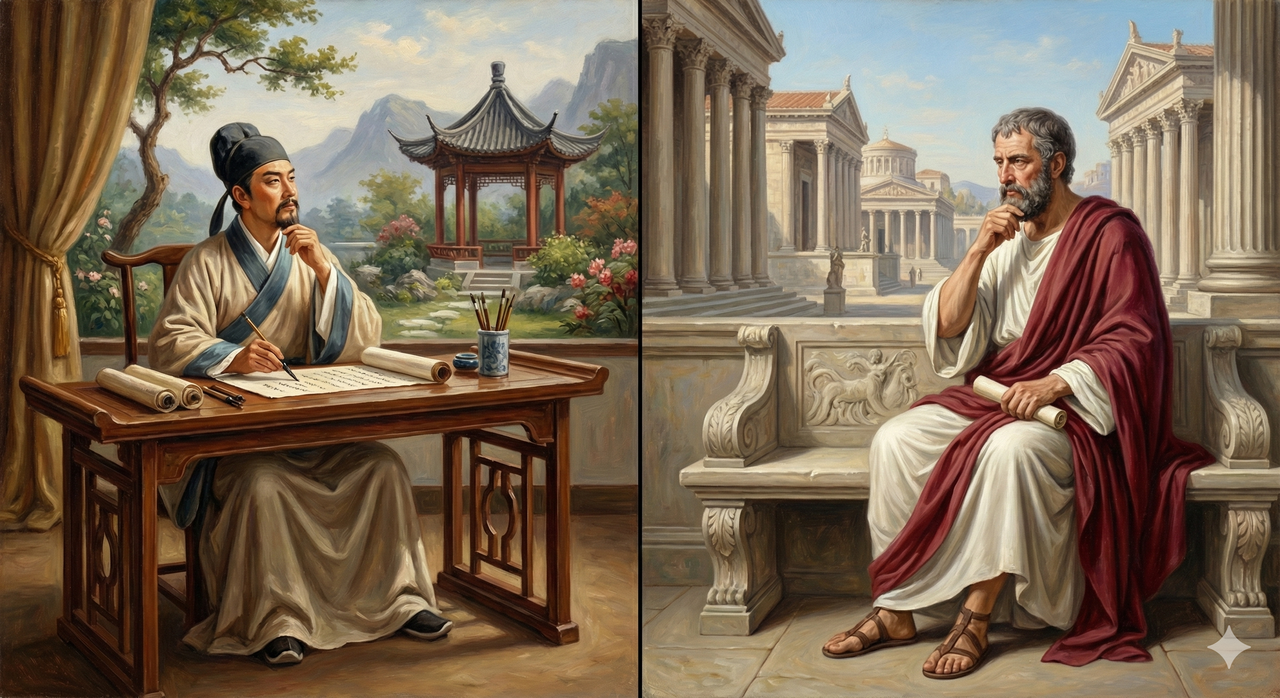
Exploring the underlying logic of Eastern and Western astrology: how Western astrology and Chinese BaZi decode fate from different dimensions, and why combining them offers a more holistic life insight
The "Raw Materials" of Destiny
Whether Eastern or Western, the study of "Ming" (命, destiny/fate) calculates personal fortune based on birth time, branching into two distinct models:
- Stellar Astrology: Based on actual celestial movements (the classic Western astrological approach)—known as "Western Astrology"
- Calendrical Destiny: Based on mechanized mathematical cycles (China's unique numerological tradition)—known as "BaZi" (八字, Eight Characters)
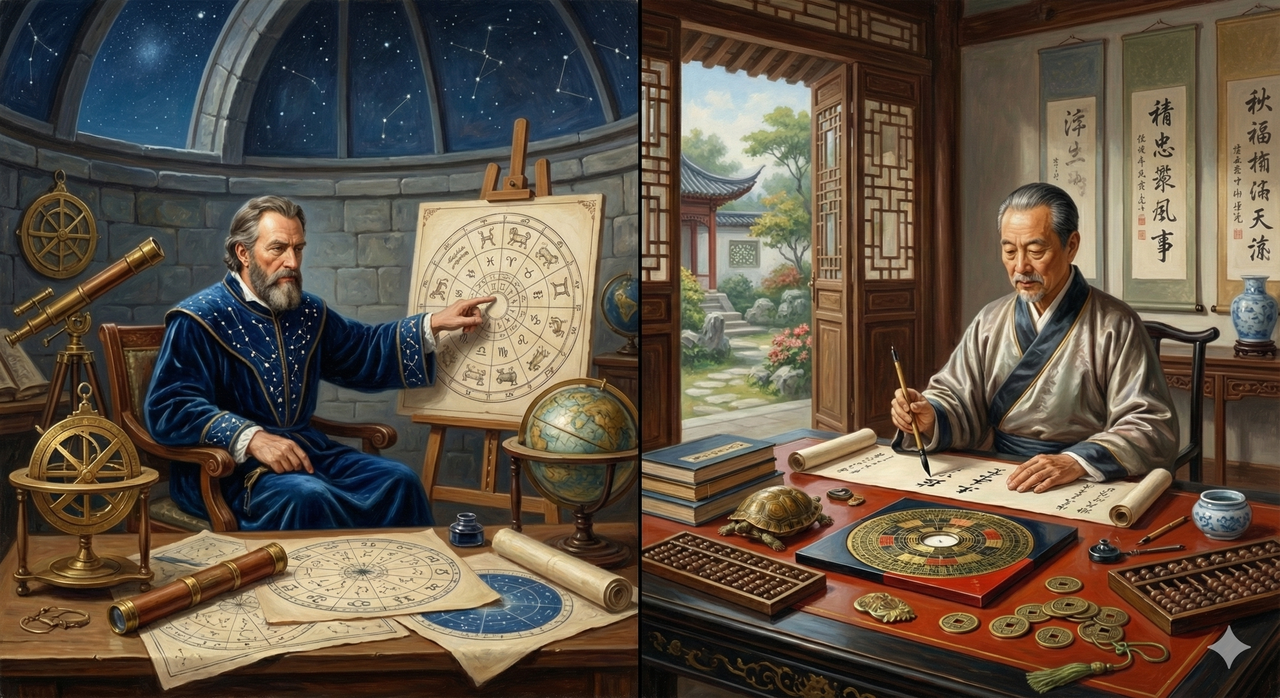
Western astrology is like a cosmic "snapshot." At the moment of your birth, it records where the Sun, Moon, and planets fell among the zodiac signs and houses, and how they interact with each other. It emphasizes the inherent energy and mythological symbolism of celestial bodies—Mars represents action, Venus represents love. When engaging with astrology, you might find it remarkably nuanced in analyzing your personality motivations, psychological needs, and subconscious patterns, as if reading a psychology report about your soul.
BaZi, on the other hand, is a logical encoding of "natural balance." It doesn't observe specific stars but captures the "Qi" (气, vital energy) of your birth moment—the Five Elements (Wood, Fire, Earth, Metal, Water) expressed through Heavenly Stems and Earthly Branches. BaZi is more like studying the relationship between a person and their surrounding environment, examining whether your energy runs too hot or too cold, whether you need water to nourish or fire to warm you. It leans toward structural observation, using the generating and controlling cycles of the Five Elements to deduce a person's life rhythm and environmental fluctuations.
The way these two systems communicate also feels remarkably different.
Modern branches of Western astrology (especially contemporary astrology) often carry a strong humanitarian and psychological analysis flavor. It tells you "why" you think the way you do, helping you change behavior through self-awareness. BaZi, as an Eastern traditional numerological art, is fundamentally about harmonizing with nature. It tends to tell you how environmental energy flows during certain phases, advising whether you should "advance" or "retreat"—embodying a distinctly Eastern philosophy of living and a rhythmic sense of destiny.
Humans: A Complex System
In my view, the study of "Ming" is a fusion of internal motivation and external environment, micro-level psychology and macro-level narrative. No single piece of advice or prediction fits everyone.
As the I Ching says: "Heaven moves vigorously; the superior person thus strives unceasingly." The ultimate path to changing one's fate lies in gathering as much information as possible, then taking sovereign action over your own life.
When you begin combining these two systems, you'll find yourself transitioning from viewing a "flat photograph" to watching a "3D movie."
First, this combination helps you align "inner awareness" with "external timing."
Western astrology excels at excavating your deep psychological structure—why you feel insecure in relationships, or what aesthetics naturally attract you. It's like a detailed psychological manual, revealing the underlying logic of your personality. BaZi, meanwhile, is more like a "life weather forecast," telling you through the flow of Five Elements whether you're currently in life's "spring" or "winter."
When you understand both your personality preferences (astrology) and clearly perceive the current environmental momentum or resistance (BaZi), you can more calmly decide whether to "sail into the wind" or "wait patiently," avoiding wasted energy at the wrong moment.
Second, combining both systems provides mutual verification and fills blind spots.
Any single predictive system may have visual blind spots. But if astrology and BaZi give similar signals on the same issue, that signal's reliability increases dramatically. For instance, if astrology shows dramatic changes in your career house while BaZi also indicates you're in a phase of intense Five Element transitions, this "resonance" provides an unmistakable alert.
Conversely, if the two systems give different feedback, it often means you need to reflect from different levels: Has my mindset changed (astrology feedback), or has my real environment changed (BaZi feedback)? This multi-perspective observation helps you face life choices with less blindness and more clarity.

We don't advocate blindly applying any old system to yourself without examination.
Don't fixate on any single conclusion. Learning to understand yourself, change yourself, and live authentically from a broader life perspective—this is our product's ultimate vision.
But I'm Just So Anxious
In today's uncertain macro environment, as individuals, we're like sailors on a long voyage unable to predict the weather. This sense of uncertainty and passivity about the future genuinely produces an exhausting helplessness. The anxiety we feel is actually a legitimate defense mechanism seeking security.
In BaZi's logic, energy ebbs and flows. When external energy is at a low point or in a controlling state, forcing breakthroughs often leads to massive internal depletion. The best advice then is to pull your gaze back from the noisy external world and focus on small things you can actually control. Perhaps it's just finishing a book earnestly, improving a professional skill, or simply maintaining a regular schedule. Amid macro-level anxiety, rebuilding a sense of control through micro-level certainties is the most effective breakwater against mental exhaustion.
From astrology's perspective, this collective anxiety often signals the loosening of an old value system. When you stop dedicating so much energy to complex relationship dramas, this is actually the perfect time to build your "inner core." You can use this period to explore where your Moon sign's deep sense of security truly comes from—is it from accumulated knowledge, spiritual richness, or sensory pleasure? When you shift focus from "what is everyone else doing" to "what does my soul need," that sense of drifting crisis gradually fades.

Afterword
Finally, I'd like to share a passage from Teacher Guan Jingxiao:
"Everyone arrives carrying a spark of spiritual light, yet most squander it entirely on empty fame, trivial pursuits, endless desires, and negative emotions—living their whole lives through others' eyes and judgments, regretting only at death's door that they never once lived as themselves.
Buddhism speaks of original true nature; Taoism speaks of finding the true self. Both simply help people see their original face.
The celestial stars shine brilliantly because each has its own orbit and rhythm of movement—mutually attracting yet never interfering—thus radiating unique light.
May everyone become the master of their own life."
All illustrations by artist: Gemini3 Pro
Share freely; commercial use prohibited.